Marx Zang, Gabriel P. AndradeResearch
Nobody is Paying for Good Forecasts on Purpose
Why order-book prediction markets run on rent, and the true costs of information aggregation.
Table of contents
- 0. The Distribution of Losses
- 1. What the Data Clearly Tells Us
- 1.1 The Winner's Profile
- 1.2 Insiders Aren't the Answer
- 1.3 Acute vs. Chronic Extraction
- 2. The Missing Noise Trader
- 3. Screening, Not Spread
- 4. The Price On-Screen vs. the Price That Pays Out
- 5. The Prices Don’t Add Up
- 6. Who Should Pay for a Forecast?
- 7. Wrapping Up
- References
0. The Distribution of Losses
Over 100,000 Polymarket wallet addresses have lost at least $1000 since the start of 2025; barely half that many addresses have made as much. The count comes from an analysis by Akey, Grégoire, Harvie and Martineau (2026) of every wallet active on the platform over that period, and the aggregate behind it is even more stark: outside a small set of (likely automated) winners, participants lost $131 million.
We can read these numbers through two lenses, and they tell opposite stories.
The first is a story about skill — that retail traders are bad at forecasting. These markets pay for accuracy by transferring money from the inaccurate to the accurate, so the losses are the system working as intended.
The second is a story about structure. The venue doesn’t need its participants to be bad forecasters to take their money, because the mechanism underlying its prices was never built to reward accurate forecasting in the first place. Through this lens, the losses are not a tuition cost but the operating revenue the mechanism runs on.
Both lenses agree the system is working as intended, but diverge on what it is intended to do. The distinction matters because the two readings prescribe different fixes. If the problem is skill, the fix is disclosure (e.g., warning labels, education, experience) and time. If the problem is structure, the fix is a different mechanism and a radical redesign is required.
This post makes the case for the second reading: a market maker on these venues is not paid a fee for making the price informative; instead, they earn a rent extracted from the predictable side of the book. The mechanisms that do make prices informative lose money on purpose. That loss, we will argue, is the honest price of a forecast.
This is a companion to our recent paper, written with collaborators at the University of Tokyo, in which we build the underpinnings of the argument here. The paper is framed against prior work, and contains the full proofs and data analysis; this post carries the motivating context behind the questions we asked and the argument underlying the conclusion we reached.
1. What the Data Clearly Tells Us
Two facts about prediction markets on the most popular platforms today are well documented, and they point in one direction: the winners are not the people who know things, but the people who quote them.
A note on scope : The account-level record below comes from Polymarket. This is not because Polymarket is unusual, but because (as a partially on-chain venue) it is auditable. The problems being surfaced are a property of the order book mechanism rather than of the brand running it, and Kalshi (the other mainstream platform) runs an order book too.
1.1 The Winner's Profile
Akey, Grégoire, Harvie and Martineau (2026) studied $67 billion of Polymarket volume over 588 million trades, and sorted participants by realized profit. Three of their findings, taken together, are hard to square up against the commonplace talking point that retail traders are simply bad at this:
- Gains are so concentrated that the average becomes a deceptive summary statistic; the top 1% of profitable accounts capture 76.5% of all profits.
- The winners sit on a particular side of trades — successful accounts provide liquidity with limit orders that resolve favorably, while unsuccessful accounts take liquidity with market orders.
- Examining the largest winning accounts directly, the authors conclude that insider trading is unlikely to explain their performance.
Viewed in tandem, these results say the winners are not distinguished by what they knew. Winners are distinguished by whether they were the one being hit or the one doing the hitting.
Akey, Grégoire, Harvie and Martineau (2026) finds roughly 69% of accounts underwater since 2022. Other analyses have independently reached the same conclusion. A wallet-level analysis from April 2026 by Sergeenkov (2026), correcting for wallets that split and merge, puts the share of wallets that have never been profitable at 84.1%.
A distribution in which passive traders systematically win is consistent with more than one economic story, including ordinary market-making accounts in which the spread is simply the price of bearing risk. On their own, these findings constrain the explanation without identifying it exactly. But, they do rule out the standard story about a market that rewarded good forecasters and penalized bad ones since the winners are pointedly sorted by their order type rather than their accuracy. Whatever the passive side is being paid for, it is not foresight.
1.2 Insiders Aren't the Answer
The obvious objection is that somebody knew something. The objection is well-founded and well-documented, but it cannot account for everything it would need to explain.
Taken at its strongest, the insider explanation is straightforward. Prediction-market contracts are not written on random draws but on outcomes that identifiable people control — a policy decision, a military operation, the timing of a signature. Anyone who knows what a principal will do, and when, is not forecasting; instead, they are reading off an answer key. Accordingly, the trades that follow have a specific fingerprint. Federal prosecutors charged a Google employee over contracts tied to nonpublic company data, and the Justice Department charged an Army soldier who helped plan the operation to capture Venezuela's president and made roughly $400,000 betting on it. More than forty lawmakers have written to the CFTC about federal employees trading on their own work, a House committee has opened an investigation, and both major venues (Polymarket and Kalshi) have rolled out screening guardrails that critics call inadequate.
A second, less discussed, channel that produces insiders requires no privileged access and only capital. Dai, Jia and Yu (2026) document settlement manipulation on short-horizon crypto contracts on Polymarket. Specifically, they identified cases where somebody pushed the underlying settlement criteria (in this case, a token price) across a threshold seconds before resolution; thus a previously losing position “suddenly” settles as a winner. Nobody involved knows anything the rest of the market does not, so the entire edge is size and speed. In the affected cycles, 821 of roughly 243,000 accounts took $8.2 million, with 93% of the loss falling on retail, and liquidity migrates toward the underlying crypto exchange as it happens.
Regardless of how they came to be, insiders are takers. They hold a signal with an expiry date, so they lift the offer since a resting order that might never fill is worthless to someone whose edge decays in hours (or even seconds). It also makes insiders the natural enemy of makers, since a stale resting quote is an invitation to be picked off. However, if insiders were the dominant winners, winning accounts would cluster on aggressive taking. Instead, they cluster on passive market making.
1.3 Acute vs. Chronic Extraction
We’ve now identified two kinds of extraction that can run on the same venue, and they fundamentally differ. Insider trading and settlement manipulation are acute; they’re prosecutable (or nearly so), concentrated in particular contracts on particular days, damaging to the platform's legal position and to whoever happened to be quoting against them when they fired. The passive maker-side extraction seen on most winning accounts is chronic; it runs every day, on every contract, against whoever is on the wrong side of a resting order and it’s baked into (arguably encouraged by) the market mechanism itself.
Acute extraction may well be more pervasive than records show. Existing analyses concern the largest winners specifically, rest on inference from trading behavior rather than direct observation of who knew what, and cover only part of the sample. Nevertheless, acute extraction cannot become chronic; however big it turns out to be, acute extraction stays tied to particular contracts, particular days, and particular people.
Passive maker-side extraction is none of those things. It isn’t tied to a particular contract, particular day, nor particular person — no rule is broken when a resting order collects from whoever crosses it, and is just the mechanism operating as designed. As highlighted at the top of this post, the two forms of extraction call for different responses. The acute one already has a remedy of the ordinary kind and, however imperfectly it works, the charges, investigations, and guardrails of Section 1.2 are that remedy being set in motion. The chronic one cannot be prosecuted nor disclosed out of existence, and the only lever that reaches it is the mechanism itself. The rest of this post is about the latter.
Before we let the acute channel exit the story, one interaction between the two is worth carrying forward. When a manipulation window opens on short-horizon contracts, the makers do not widen their quotes and charge more for the danger. Instead, makers pull quotes entirely and leave the book. In Section 3 we’ll return to why, explaining how the exit is the chronic channel's everyday behavior that the manipulation window's predictability drags to the surface.
None of this disputes the strongest shield that today’s popular venues wield when defending themselves — that their headline prices have often been good. Polymarket's 2024 election numbers famously ran ahead of the major polling averages and were vindicated by the outcome from Tsang and Yang (2026). However, the argument here isn’t about calibration (though we will put some pressure on that in Section 5). Chronic extraction runs beneath calibration, through who is holding which side when the contract settles. Everything so far has been about who trades and who wins, whereas the remainder of this post is about what the winners are being paid for — and why, once you ask that question carefully, the order book turns out to be the wrong place to look for a good forecast.
2. The Missing Noise Trader
The standard defense of the bid-ask spread rests on a trader who does not exist here.
Consider the classic arrangement the spread is supposed to describe. In the Glosten and Milgrom (1985) account of a dealer market, the maker posts a two-sided quote without knowing who will hit it. Some of the flow is informed, and the maker loses to it every time, by construction. The rest is uninformed — the so called "noise trader" in market-making models — and the maker wins from that side on average. The spread settles at the width where the winnings from the uninformed cover the losses to the informed.
Two features of their construction are worth honing in on, because both are crucial for understanding why, when, and how the spread typically works.
First, the uninformed trader buys immediacy and pays for it; the informed trader gets to act on their signal; the price ends up carrying the information. Nobody in the story is being exploited, and the maker's profit is the fee for running the mechanism that makes the price informative.
Second, the uninformed trader has to have a reason to show up. They are in the market because the asset does something for them, e.g. hedging an exposure, rebalancing to a mandate, raising cash, or acquiring a claim on a stream of future cash flows they actually want. Their flow is uncorrelated with the payoff because their motive is independent of which way the price goes next, and that is what makes it a reliable subsidy rather than a one-time transfer.
What is missing in prediction market is that motive, and its absence is inherent in these markets’ purpose: the outcome shares has no consumption value, no governance rights, no coupon, no residual claim, and no use of any kind besides at resolution. There is nothing to hedge with it, nothing to rebalance into it, and no reason to hold it other than expressing a view about the event. It is a contingent claim that either pays a dollar or nothing and then ceases to exist. (To be clear, certain contract types are real exceptions, e.g. claims on inflation or interest rates can offset real exposures. However, the categories that carry the highest volume on popular venues today are politics, sports, and short-horizon crypto.)
So, intuitively, where an equity dealer is paid by people who wanted the stock for its own sake regardless of price, a prediction-market maker has little or no such customer. Whatever the maker earns has to come out of someone's forecast being wrong in a direction the maker can anticipate, or they cannot quote against it.
The obvious objection is that plenty of people clearly do trade these contracts for reasons other than expected profit. People trade prediction markets for entertainment, for expression, for the pleasure of holding a position on something they care about, and for the particular appeal of a long-shot payoff — the same recreational demand that has kept racetracks and sportsbooks in business for a century. The question is not whether such traders exist, but whether their flow has the property the Glosten–Milgrom accounting requires.
Stated plainly, it does not. Classical noise is uncorrelated with the state, but demand for long-shot payoffs is state-correlated by definition; it concentrates on contracts trading at low prices, it varies with how uncertain the event is, and it therefore arrives in a pattern that a maker can predict from the state of the world. With that one property upended, a maker’s rationale inverts: where a maker facing uncorrelated flow earns a spread for bearing risk, a maker facing state-correlated flow earns something else entirely.
The empirical grounding for that substitution is the favorite–longshot bias, where bettors systematically overpay for long shots and underpay for favorites. The pattern was first documented at American racetracks in the 1940s and has been reproduced in betting markets ever since. However, in prediction markets, the familiar phenomenon behaves in a way that a pure taste for gambling doesn’t explain.
We studied the complete transaction record of Polymarket's five-minute bitcoin UP/DOWN contract over roughly twenty-four hours, capturing 738,393 trades across 275 consecutive markets. Throughout that data, the bias does not hold a fixed sign; it reverses with the market's volatility regime. In other words, when prices trended one way, a side priced near 29 cents won about 7% of the time. When prices kept reversing, the same-priced side won about 37%. That said, a constant preference for long shots cannot produce a preference that flips, but a demand that responds to the state can. Our model takes that state-dependence as a starting point.
3. Screening, Not Spread
A market maker who cannot be paid to absorb informed flow has one card left to play. They cannot widen their way to solvency — a narrower loss is, after all, still a loss at the end of the day. Without uninformed flow paying the spread, there is no revenue for any width to defend. What the maker can control is where the quote sits relative to the signal that has not yet arrived.
Consider a maker quoting ahead of a public signal (e.g., a data release, a settlement print, or a headline) that will move the market's belief somewhere inside a known band around the current price. Whoever sees the signal first hits any quote still resting inside that band and pockets the difference. An equity dealer eats the same loss and recovers it from the noise traders through the spread; Section 2 established that here there is no such flow to recover it from. The problem is not the size of the loss to informed traders (a.k.a. adverse selection) but the absence of any counterparty who pays the maker for bearing it. In other words, a quote inside the band serves as a giveaway instead of as priced risk.
The competitive quote consequently sits outside the band. Stated informally, rather than being the price of liquidity, the spread here becomes the width of the region the maker refuses to trade in.
That diagnosis diverges cleanly from the traditional view of spreads, where a dealer facing a larger anticipated shock widens while knowing uninformed flow will trade regardless and keep paying them. A maker with no such flow has no width worth defending, so they leave altogether.
Polymarket’s five-minute bitcoin UP/DOWN contracts test this hypothesis repeatedly and on a specific cadence. As settlement approaches with the price near the threshold, we’d expect the band is at its widest since the final seconds can flip the resolution outright (whether through ordinary volatility or manipulation). Dai, Jia and Yu (2026) find depth vanishing exactly there. Importantly, the makers were not necessarily fleeing manipulation, as their behaviours align with what a maker does whenever the band swallows the quote and they’re left without a funded spread. All the manipulation window did is make the moment predictable enough to show up in data.
The natural consequence of spreads evaporating in this way is that informed flow is screened out of the book entirely. It doesn’t vanish, but is routed to a venue that won’t refuse it. In our model, we study an order book running side by side with a cost-function automated market maker (AMM) on the same event. A cost-function AMM (the canonical design being Hanson's logarithmic market scoring rule) quotes a price for every trade at every moment by construction, and cannot pull its quote the way the book's makers do. Hence, informed flow routes to the AMM while the order book keeps the flow that remains.
The flow bifurcating into informed vs. uninformed like this raises the question at the center of this post: what is the market maker actually being paid for?
We’ve seen that they’re effectively aiming to decline trades with anyone who knows anything of substance about the event. And, in our data, we found that maker revenue is not coming from the spread at all. Makers carry the mispriced side of the state-correlated demand to resolution and collect when it settles. Call it a screening rent, the return from standing on the correct side of a predictable mispricing that gets realized at settlement rather than earned on a round trip.
That distinction has a discernible fingerprint. A maker earning a traditional spread accumulates profit through the life of the contract by turning inventory over, whereas a maker earning a screening rent books almost everything at resolution. In our data, that is exactly what happens; 91.4% of the persistent makers' profit arrived at settlement, and less than 9% came from the buying and selling before it. Across the same twenty-four hours, the 407 accounts that persistently made markets ended up $45,300 while the 12,749 retail accounts ended down $66,700, and the side the makers carried into settlement resolved in their favor 56.8% of the time.
With these observations in mind, a standard industry-wide perception of a “venue hierarchy” gets flipped. Typical discourse (especially around centralized vs decentralized exchanges) paints a picture where the order book is the serious, high-volume price-discovery venue and the automated market maker is a niche, retail convenience. However, in a market with no consumption value to generate noise, the ordering reverses. The automated market maker becomes the venue where information enters the price, and the order book sustains itself on behavioural rent.
The two therefore coexist rather than compete, which is the result at the center of our paper. They are not fighting over the same flow; the book takes the state-correlated demand and the rent that comes with it, while the cost-function AMM takes the informed flow and pays for it out of subsidy, recovering part of that loss through the margin the book's rent leaves available. Coexistence itself is not new, and the two venue types already share assets across crypto markets. Aoyagi and Ito (2025) modeled that arrangement for conventional assets, but what changes without the conventional noise trader is who sorts where.
Note on scope: The argument above is a model result that holds under conditions stated formally in our paper, i.e. a common signal with a bounded band, competitive quoting, and state-correlated demand with the regime-dependence our data contained. Relax that last assumption, and the order book maker's rent has no source; the model then recovers a more standard adverse-selection market as a special case.
4. The Price On-Screen vs. the Price That Pays Out
Screening rent is a claim about, and a function of, who the market maker's counterparty is. On some contracts, you can identify said counterparty and surface sources giving rise to the rent extracted.
Disclaimer, and a Note on Context. In August 2026, between when we began working on this paper and published this post, Polymarket changed the settlement rules and description we discuss throughout this section. The five-minute bitcoin markets now settle on a 60-second time-weighted average price (TWAP) rather than a single instantaneous price. That narrows the exploitable window, but it still does not label the chart. Some specific details (and wording) of what we highlight are no longer true, but the overarching argument still holds.
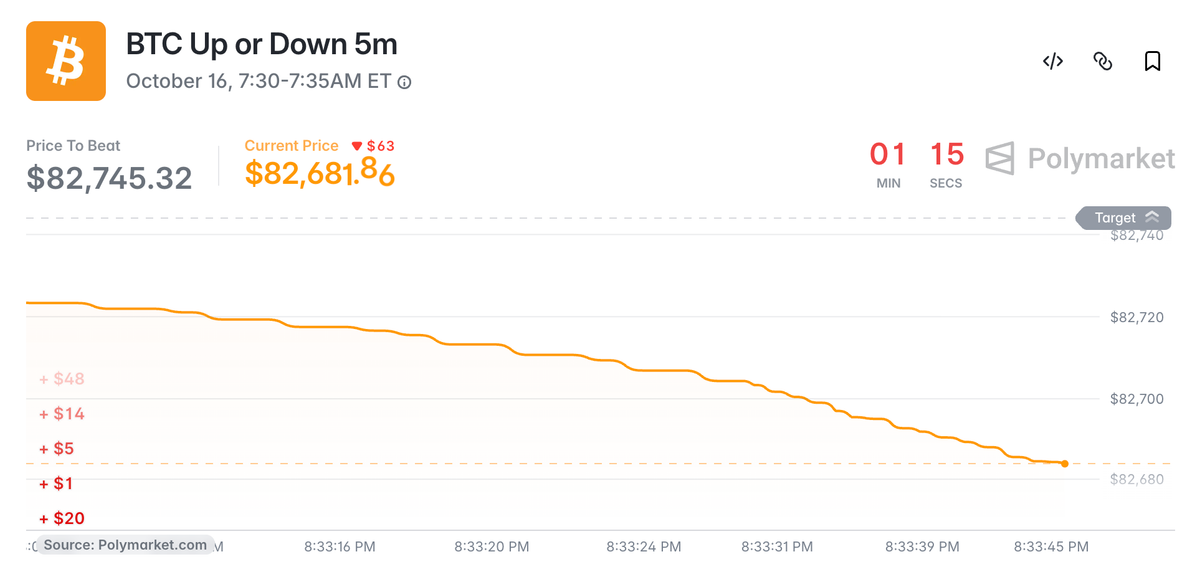
Polymarket's five-minute bitcoin market is arguably the cleanest case we have. A binary market opens every five minutes, pays a dollar if you called UP or DOWN correctly, and settles automatically. The design is simple, yet that simplicity is precisely what makes it easy to dismiss the importance of asking which bitcoin price you should be trading against. If you do ask that question and dig a little, what you may expect to be a straightforward answer turns out to be shrouded in a veil of nuance; each of these markets feature three price charts that differ in subtle ways.
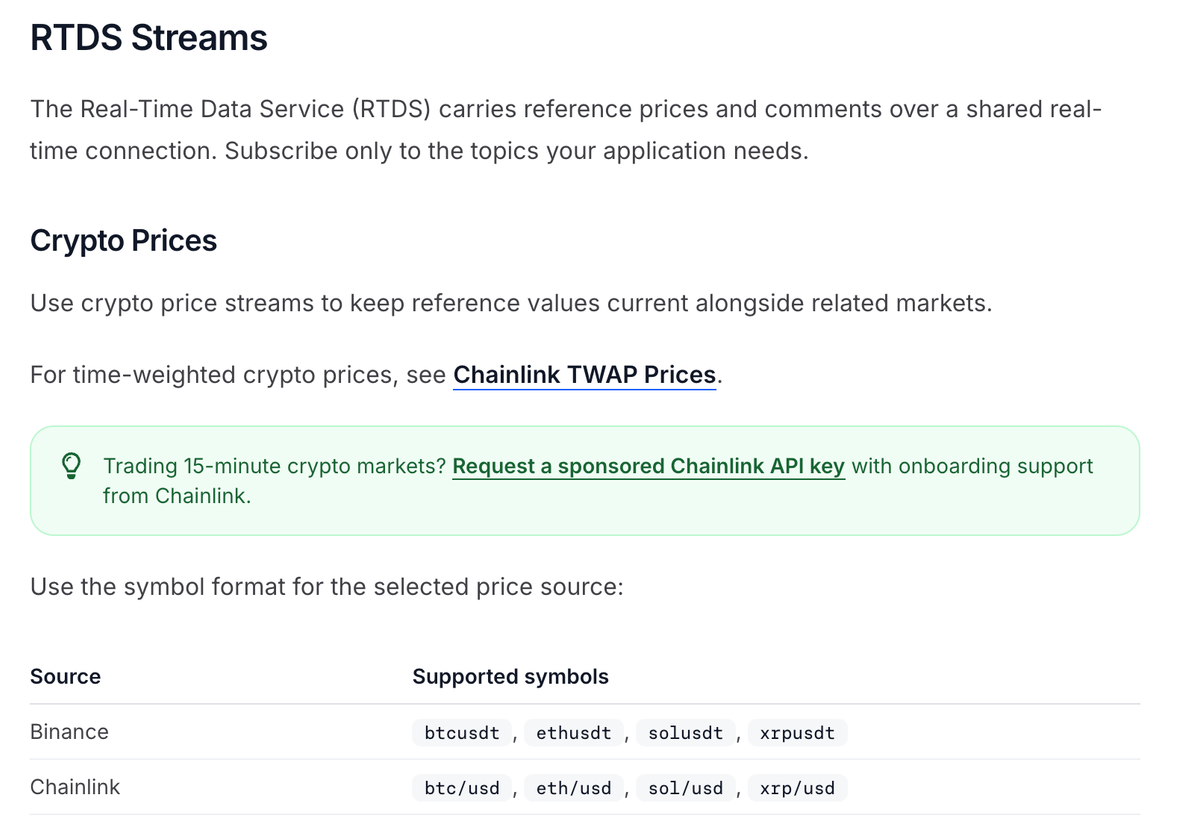
1. The price charted at the top of the market’s main page. The line moving on Polymarket's own market page is labeled "Source: Polymarket.com," which is not a source. Polymarket's documentation lists several separate crypto price topics on that same socket — raw Binance ticks, raw Chainlink ticks, the Chainlink TWAP — yet never says which one the chart draws from. A trader encountering these markets for the first time may assume this chart is the source of truth for market settlement, but the reality isn’t so straightforward. In figure 1 we give an example screenshot of one such price chart featured at the top of these market pages, and in figure 2 we show a screenshot of the sources of this chart as described in Polymarket’s own documentation.
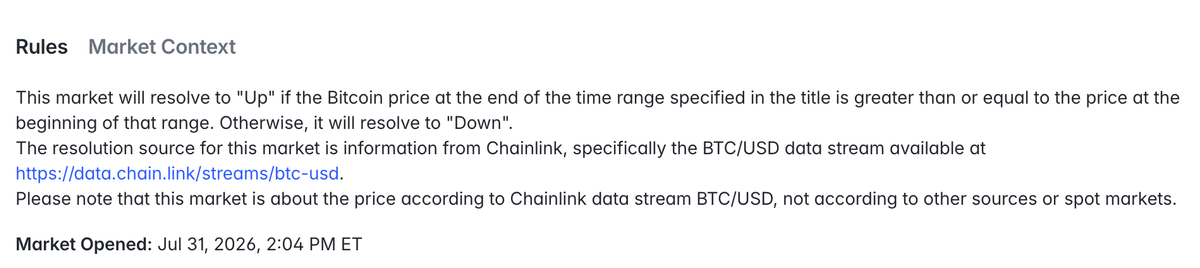
2. The price chart linked in the market’s description. In the description of the markets rules, traders are provided a link pointing to another chart tracking BTC prices (specifically, to data.chain.link/streams/btc-usd). The market description simply states that the resolution source is available at the link, but the default chart presented when somebody clicks into the link isn’t quite that resolution source. Rather, the default chart shown is a coarser view of the actual data stream used. A trader reaching this chart without reading the rules critically or questioning precisely what the default chart shows could again reasonably assume this chart is the actual source of truth for settlement — but, again, the reality isn’t so straightforward. In figure 3 we give an example screenshot of the exact description of the market rules given in one of these markets. In addition, in figure 4 we show a screenshot of the default page reached through the link in these markets’ rules; to their credit, the default reached through these links does state that the price shown is delayed and "for informational purposes only."
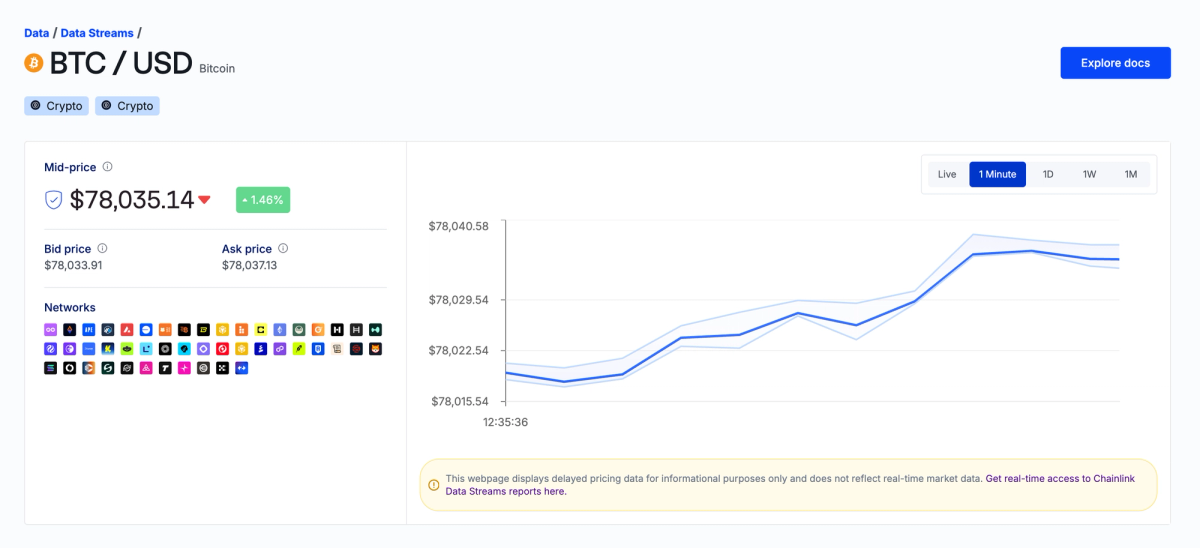
3. The price that ultimately pays out. By digging deeper, one finds that these markets’ contract settles on a specific data feed documented separately. Namely, Chainlink's BTC/USD stream at the instant of resolution. This is a different number from the chart linked in the market rules we discussed in (2) and, as far as anything published tells us, a different number from the chart on the main market page from (1). To find this data source, a trader would need to look past the other charts we’ve highlighted, … click the right link, switch to live price, register for Chainlink, and pay for at least $150 a month to unlock the API for this price.
Please see the disclaimer at the top of this section for clarification about changes made by Polymarket on August 8th.
The page from (2) discloses its delay and, once identified, the settlement feed in (3) is precise, but the chart prominently displayed on the market page from (1) discloses nothing. Polymarket has functionally laid out a set of tools that’re almost indistinguishable to most people, set a goal that can only be reliably accomplished with one very specific (and pay-walled) tool, then formulated a zero-sum game with an open invitation to the public. Sticking to this analogy, retail traders may never even realize the tools set in front of them differ at all and, given the apparent simplicity of the goal in this game, may never think to ask if the tool they actually need isn’t among the ones they’re handed but instead is stored out of sight in some drawer. By contrast, market makers come in while already owning the exact tools they need (and likely other nice-to-have accessories) while being offered additional rebates for playing the game at all.
Dai, Jia and Yu (2026) measure what the gap in some of these tools is worth. They found that the Binance midquote sits roughly two and a half basis points from the oracle print, tracks it nearly one-for-one inside each five-minute window, and lands on the same side about 85% of the time. So, someone watching and trading Binance directly isn't forecasting the outcome; they're reading it a few seconds before, or directly manipulating the settlement against their counterparty, who is watching a wrong or delayed price chart.
This is precisely the counterparty our model requires and anticipates, and Polymarket's own interface helps to manufacture it. In other words, screening doesn't need a trader with a bad forecast. It just needs a trader whose orders arrive at “predictably wrong” prices, and the feeds Polymarket makes readily available from its market pages all but ensures the over/under-pricing is predictable for traders not savvy enough to spot these slight deviations from the actual source used for settlement; a maker tapped into the settlement-grade feed sees which way the price might go wrong before the retail chart ever has a chance to catch up. A retail trader's judgment and rationale didn’t necessarily fail, but the endpoint they were pointed to almost certainly did.
Each piece has an innocent explanation in isolation. Push-based feeds like (1) and (2) have heartbeats because on-chain writes cost money. Likewise, pull-based feeds like (3) cost money because maintaining these low latency streams does. A 300-second contract like these BTC UP/DOWN markets is short enough that the difference between these feeds becomes monumental in deciding outcomes. Polymarket didn't invent any of these constraints, but it did build a market whose constraints cut in a unified direction, against a specific cohort of trader. They also happened to build it in such a way that a crucial label was left off the screen these traders likely look at, which makes it less likely for them to notice they’re being systematically nicked as they participate.
This asymmetry was not subtle to the people on the winning side of it, nor was it private. The losses taken on by price takers accumulated in public, on a blockchain, for months. One expects that a platform that is truly indifferent to who wins in its markets would fix an unlabeled chart as soon as someone points it out — especially when said platform loudly and publicly affirms its commitment to honest information aggregation and this chart seems to be methodically mis-calibrating trader beliefs on some of its most popular, voluminous markets. Of course, that stands in stark contrast to a platform with every incentive to let a gap like this run until forced to close it, since their volume depends on retail traders continuing to show up for liquidity their market makers only provide when they’re able to extract rent from reliable mis-calibration.
We obviously cannot see inside decisions made by these platforms, nor do we claim to know how decisions are made or prioritized. However, we can see the decision's qualitative shape and apply Occam’s razor while hypothesizing: what we saw is a data feed structure that reliably transfers money from the people reading the most visible charts to the people reading a pay-walled and understated settlement feed, and that feed structure was sustained long past the point where venue operators could reasonably claim to not know…
5. The Prices Don’t Add Up
Everything we’ve been discussing above has concerned a binary contract. The comparison gets worse for the order book as soon as the event has three (or more) outcomes.
The standard construction is to run one binary book per outcome: a separate "will X win?" market for each candidate, where each has its own book and its own depth. This is nearly universal, but has a critical defect built into it. Every trade that expresses a preference between outcomes on such a set is a swap (i.e., buy the candidate you favor, sell the one you don't) and the price of a swap is a difference of two quotes. Trading therefore hardens the differences and never the common level of the quotes. Yet, the level is exactly where the probability (the “prediction” part of “prediction market”) lives. In our model, this becomes a precise statement. A maker can shift every quote up or down together, changing the displayed "probabilities" on every screen, without a single order executing and without anyone's payoff changing in any state of the world. Which means the displayed number is one nobody has to bet on to move.
Intuitively, separate binary books are separate opinions about the same event, and nothing in the books forces them to add up. The yes-prices across an exhaustive, mutually exclusive set need not sum to one, and on sets without outside help they routinely do not — we give two examples of this in figure 5. (Polymarket has built itself a patch for this, which we return to in a moment.)
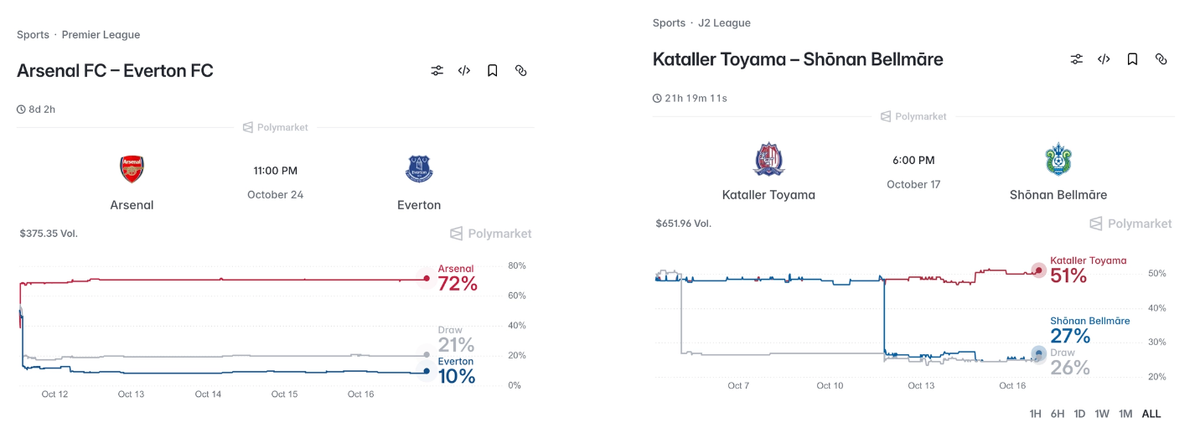
Our discussion from Section 3 makes this worse, since the competitive quote sits outside the no-pickoff band. The displayed ask is not the maker's belief about the outcome, but the edge of the region the maker refuses to trade in. By reading one book, you’re reading a refusal boundary. Hence, perhaps unsurprisingly, reading of them as a unified belief has no inherent interpretation as a probability.
The reflexive answer is that any gap is an arbitrage, so arbitrage will close it. That reflex is right about the existence of the trade, but doesn’t account for its cost. Closing a wedge across books requires simultaneous capital in all , held to resolution, exposed to each book's depth and each book's fees, and paying once at settlement in an amount bounded by the wedge itself. Nothing about that is impossible. It is expensive enough, and slow enough to pay, that the wedge often persists.
Polymarket, to its credit, noticed and deployed a partial patch. For winner-take-all events it deployed a conversion layer (dubbed the "negative risk" adapter) that collapses the -legged arbitrage into a single transaction, and on those events the yes-prices do hold near a dollar. Reading between the lines, that patch is a concession, since the books alone supply no adding-up constraint and hence the venue needed to bolt one on from outside; they essentially hand-built a fragment of the cost function it chose not to run. The patch reaches only the sum of price, though. A normalized display is still a display nobody bet to place, still offset by the premium, and only existing in specific contracts where it's deployed.
We ran the rough check on real transaction level data provided by Akey, Grégoire, Harvie and Martineau (2026) . Buy YES on every outcome of an exhaustive set of outcomes at the ask, and the bundle pays exactly one dollar no matter what happens. So, anything a taker paid beyond a dollar is the price of extracting one coherent belief from the set of books. On the most liquid three-outcome markets that excess ran to about two cents; on liquid binaries, about one cent. To be fair to order books, part of that is mechanical since each leg pays its own half-spread even when the midpoints are perfectly coherent ( books quoting spread cost about $ns/2$, so a one-cent binary predicts a cent and a half at three outcomes before any incoherence at all). However, a two cent discrepancy hints at something past just mechanical scaling, but a single comparison cannot pinpoint what exactly. Regardless, the mechanical part suffices for the argument here; the cost of buying coherence out of a set of order books grows linearly with the number of outcomes when they are implemented.
A cost-function market maker charges nothing for that coherence, and not because it is better run. These AMMs are an entirely a different object since they’re mechanisms designed to price the whole probability simplex directly, so coherence is baked into their DNA. Stated plainly, prices sum to one because the cost function ensures it will, and not because of an equilibrium we hope traders with capital will enforce.
Cost-function AMMs are therefore more desirable for information holders and consumers since their prices are guaranteed to be well-defined probabilities, and they’re more desirable for information seekers since they are more collateral efficient for market creators whenever .
6. Who Should Pay for a Forecast?
The biggest venues today, which carry essentially all prediction-market volume, run central limit order books. That is a fact about the world despite many arguments of the kind we’ve laid out above, and the decades of active research favorable to cost function AMMs. Given that is the state of play, we believe these arguments must be paired with an appropriate explanation of why and how order book prediction markets became the industry standard.
The short version is: if information aggregation quality isn’t enshrined as a first-order priority, then the order book wins on every practical dimension.
The decisive facet in favor of order books is that nobody has to write a check before a market opens. A cost-function operator's loss is bounded, and bounded is worlds apart from free; somebody must fund that bounded loss for each market on the venue. On the other hand, an order-book operator holds no position. Operators of both mechanisms can earn fees, but only one of them requires somebody to offset a loss. To a venue deciding what to run, that historically has looked like the difference between figuring out how to run a profitable exchange vs running profitable public-goods funding infrastructure. The former has a well-understood playbook whereas the latter is a well-known problem riddled with nuance — this difference is sufficient on its own to explain the entire market structure in today’s popular venues.
Of course, other factors exist, but they only compound on top of the profitability questions. Namely: (i) The liquidity parameter has to be set in AMMs; if it’s too low then prices lurch on small trades, if too high then the market absorbs information too slowly. Nobody had a procedure for choosing it across tens of thousands of heterogeneous markets with unknown participation. (ii) An order book is legible and low friction — traders understand it, exchanges are built on it, regulators have decades of precedent for it. (iii) The loss bound is per market rather than across them, so a venue whose operator is personally subsidizing tens of thousands of contracts is committing to a bounded loss tens of thousands of times over. (iv) According to Levitt (2004), a bookmaker has to balance the money on both sides to stay solvent. An exchange holds no position itself, but its makers inherit the same constraint, and we showed (in Section 3) what they do when balance is about to fail. A cost-function operator deliberately runs unbalanced, which is why the design yields strong information aggregators…and why the design costs money.
None of this is hypothetical, because Polymarket ran the experiment on itself. They launched on an automated market maker and moved to an order book in late 2022, even though no official announcement can be found from the Polymarket’s website, several sources have inferred (e.g. here, here, and here) that the change is to make the markets more favorable to professional/institutional market makers. The fee schedule on the five-minute contracts points in the same direction, where takers pay at most 1.75% per trade while makers pay nothing.
Having laid all this groundwork, we’re ready to reframe the desiderata bluntly. An order book cannot finance information aggregation the way an equity market does, because prediction market shares generate none of the uninformed flow an equity dealer survives off of (Section 2). The choice is therefore not between a good mechanism and a bad one, but between two ways of paying for a belief over an event. The difference is who pays, their control over who they’ll pay, and whether every possible belief is always expressible as a valid trade. An order book funds price discovery with an unbudgeted transfer from whichever participants are predictably on the wrong side, but there isn’t an upfront line item being priced-in and its size is only discovered ex post by researchers doing forensics on wallets. A cost-function market maker funds the same thing with a budgeted subsidy, disclosed in advance, bounded by a number the operator chooses. In short, the cost-function AMM is more expensive on the operator's income statement while being cheaper on everyone else's. Ultimately, they’re fundamentally different products.
Which raises a question the field has mostly left unattended: if a forecast is worth having, who should be buying it?
There are real candidates — a firm that wants a probability for a decision it is going to make, an agency that wants a public risk estimate, a research funder, an exchange that monetizes the resulting data, etc. This is the program Vitalik Buterin sketched under the name info finance, which starts from the facts you want to know and designs the market backward from it. The Gates–Hillman Market (2013) at Carnegie Mellon ran a cost-function mechanism “in the wild,” with a real subsidy and a real forecast at the end of it. The demonstration was never scaled precisely because the venue operator was the only candidate to write the check backing the subsidy (and, in this case, it was academic researchers).
However, that constraint is an artifact of the product’s packaging, which has changed materially. Throughout this section, we’ve been describing one particular way of running a cost function; a monolithic operator, funding a fixed liquidity parameter, out of its own pocket, for every market it lists. That centralized construction was truly limiting in the past, but modern advances in decentralized technologies and research on information elicitation dramatically change what’s possible. A decentralized and permissionless construction distributes the obligations differently, so whoever wants a market to exist simply creates it and posts the required bounded loss themselves (a commitment that can be arbitrarily small, and non-removable, while the market lives). Due to recent work on prediction markets by Bhaskara et al. (2026), which gives a general construction for outside liquidity provisioning in cost-function markets, liquidity stops being a parameter the operator must set once and defend forever. Together, these unlock a venue wherein a creator can seed a market thinly, add more later, and let third-party LPs contribute depth they can withdraw before resolution, with liquidity scaling in the volume the market attracts. In exchange, the creator and contributing LPs take the lion's share of the market's fee revenue while the venue keeps only a cut for running the rails that make it possible. These changes preserve much of what makes order books attractive in practice, but result in a mechanism that prices the simplex and quotes every trade at every moment at every size the bound permits.
If we reread the list above in that light, we find that the landscape driving decisions in the past has changed considerably. The compounding bound of (iii) stops compounding on anyone in particular, as each market's worst case sits with the creator who chose it rather than the venue operator. The imbalance of (iv) stops being an anomaly to explain and becomes the purchase itself — i.e. the creator runs unbalanced because the creator is the party buying the answer, or the fee stream from the crowd that wants to trade it. The parameter problem of (i) dissolves into a market decision: how much liquidity a question deserves is priced by whoever expects the question to pay, in fees or in information. Under this construction an operator earns fees for providing infrastructure without needing to subsidize losses themselves, like any exchange. What was missing was a mechanism for matching the people who want a forecast with the capital willing to fund one. As mentioned previously, that is less like running a traditional trading venue and is more like running infrastructure for matching people to a service (and precedent for how to do so profitably has blown up in the last decade of the internet).
What would settle the general case is order-level data on where informed flow routes when both venue types run live on the same event — a comparison available to any platform operating both, and to nobody else. Our model already says what such a platform should expect to find at equilibrium — informed flow at the cost-function maker, the book living on its rent, and that rent margin funding part of the subsidy (Section 3). What the model poses without settling is whether a venue running both on purpose, with the cost-function maker as the aggregating backstop and the book for depth, beats either pure design on welfare (a question the LP construction above brings to life, since exitable outside liquidity is already halfway to a book). That is an open question worth exploring in future work, as is whether longer horizon contracts help in manufacturing a (traditional) “noise trader” of its own.
7. Wrapping Up
Let us return, then, to the numbers we started this post with: more than 100,000 accounts down at least a $1,000, $131 million in aggregate, and a winner's circle small enough to fit in a room.
We argued here that retail traders’ skill is only a small part of the story, and that venue structure is the underlying root of the symptoms we’re seeing in practice. Several recent works, Bartlett and O’hara(2026), Akey, Grégoire, Harvie and Martineau (2026), Burgi, Deng, and Whelan (2025) published independently, before and after we embarked on this project, support the same conclusion: the winners sit on the passive side and their income arrives at settlement from the predictable side of the book. No matter how you slice it, a better-educated trader facing that arrangement is a better-educated trader losing money more articulately.
The position we’re defending is not that order books should be abolished, but that a venue should not claim to be aggregating information while funding itself from the people who are worst at supplying it. Somebody has to pay for the forecast — that is what a bounded subsidy is at its core. Right now nobody is paying for it on purpose, which is precisely why everybody is paying for it by accident.
References
Akey, P., Grégoire, V., Harvie, N., & Martineau, C. (2026, March 18). Who Wins and Who Loses in Prediction Markets? Evidence from Polymarket. SSRN Working Paper 6443103.
Aoyagi, J., & Ito, Y. (2025). Coexisting Exchange Platforms: Limit Order Books and Automated Market Makers. Journal of Political Economy Microeconomics, 3(3), 611–648. https://doi.org/10.1086/732831
Bartlett, R., & O’Hara, M. (2026, April 16). Adverse Selection in Prediction Markets: Evidence from Kalshi. SSRN Working Paper 6615739.
Bhaskara, A., Frongillo, R. M., Lindgren, E., & Papireddygari, M. (2026). A General Theory of Liquidity Provisioning for Prediction Markets. arXiv:2311.08725.
Binance Square. (n.d.). Polymarket’s shift from AMM to CLOB. Accessed September 10, 2026.
Bürgi, C., Deng, W., & Whelan, K. (2025, September 1). Makers and Takers: The Economics of the Kalshi Prediction Market. CESifo Working Paper No. 12122.
Buterin, V. (2024, November 9). From Prediction Markets to Info Finance.
Chainlink. (n.d.). BTC / USD — TWAP: 60s Data Stream. Accessed September 10, 2026.
Dai, D., Jia, R., & Yu, S. (2026, June 30). Settlement Manipulation in Prediction Markets. arXiv:2606.31675.
Gate Learn. (2024, November 25; updated 2026). What Is Polymarket? Decentralized Prediction Market Explained.
Glosten, L. R., & Milgrom, P. R. (1985). Bid, Ask and Transaction Prices in a Specialist Market with Heterogeneously Informed Traders. Journal of Financial Economics, 14(1), 71–100. https://doi.org/10.1016/0304-405X(85)90044-3
Hanson, R. (2007). Logarithmic Market Scoring Rules for Modular Combinatorial Information Aggregation. The Journal of Prediction Markets, 1(1), 3–15.
Kalshi. (n.d.). Kalshi. Accessed September 10, 2026.
Katersky, A., & Faulders, K. (2026, May 27). Google Information Security Engineer Charged with Using Inside Information to Make $1M on Polymarket. ABC News.
Levitt, S. D. (2004). Why Are Gambling Markets Organised So Differently from Financial Markets?. The Economic Journal, 114(495), 223–246. https://doi.org/10.1111/j.1468-0297.2004.00207.x
Othman, A., & Sandholm, T. (2013). The Gates Hillman Prediction Market. Review of Economic Design, 17, 95–128. https://doi.org/10.1007/s10058-013-0144-z
Phemex News. (2025, October 20). Polymarket Shifts from AMM to CLOB to Enhance Liquidity in Prediction Markets.
Polymarket. (n.d.). Chainlink TWAP Prices. Accessed September 10, 2026.
Polymarket. (n.d.). Fees. Accessed September 10, 2026.
Polymarket. (n.d.). Negative Risk. Accessed September 10, 2026.
Polymarket. (n.d.). Real-Time Data. Accessed September 10, 2026.
Polymarket 101 Team. (2025, December 28). Why Polymarket Switched to a Limit Order Book (and What It Means for Traders).
Sergeenkov, A. (2026, April). How Many Traders Are Profitable on Polymarket.
Silverman, C., Popper, N., & Patino, M. (2026, April 28). Most Prediction Market Traders Are Losing Money While Bots Rack Up Gains. Bloomberg.
Thaler, R. H., & Ziemba, W. T. (1988). Anomalies: Parimutuel Betting Markets: Racetracks and Lotteries. Journal of Economic Perspectives, 2(2), 161–174. https://doi.org/10.1257/jep.2.2.161
The Hill. (2026, March 24). Kalshi, Polymarket Roll Out New Insider Trading Bans.
Tsang, K. P., & Yang, Z. (2026). The Anatomy of a Blockchain Prediction Market: Polymarket in the 2024 U.S. Presidential Election. arXiv:2603.03136.
U.S. Department of Justice, Office of Public Affairs. (2026, April 23). U.S. Soldier Charged with Using Classified Information to Profit from Prediction Market Bets.
U.S. House Committee on Oversight and Government Reform. (2026, May 22). Comer Launches Investigation into Insider Trading on Prediction Market Platforms.
Warren, E. (2026, March 30). Warren, 40+ Lawmakers Push Regulators to Address Illegal Insider Trading in Prediction Markets. Office of U.S. Senator Elizabeth Warren.
Continue reading