GensynResearch
Forecasting the Flu: Experimenting with median markets
The Flu Forecast Game lets anyone help forecast the 2026-27 flu season. Players call whether flu admissions will come in over or under a live community forecast. Good calls pull the forecast toward the truth and earn points, and the best forecasters win cash prizes.

Table of contents
How many people in the US will be admitted to hospital with flu next week? The Flu Forecast Game asks that question for every state, every week of the 2026–27 flu season, and lets anyone help answer it. Players call whether flu admissions will come in over or under a live community forecast. Good calls pull the forecast toward the truth and earn points, and the best forecasters win cash prizes.
What you're forecasting
Each question is a count from the CDC: new hospital admissions with lab-confirmed flu in one week, as reported by hospitals to the National Healthcare Safety Network. It's the same number the CDC's FluSight hub asks expert modelling teams to predict. There's a community forecast for the US, all 50 states, DC and Puerto Rico: a median, plus a 10th and 90th percentile for most places.
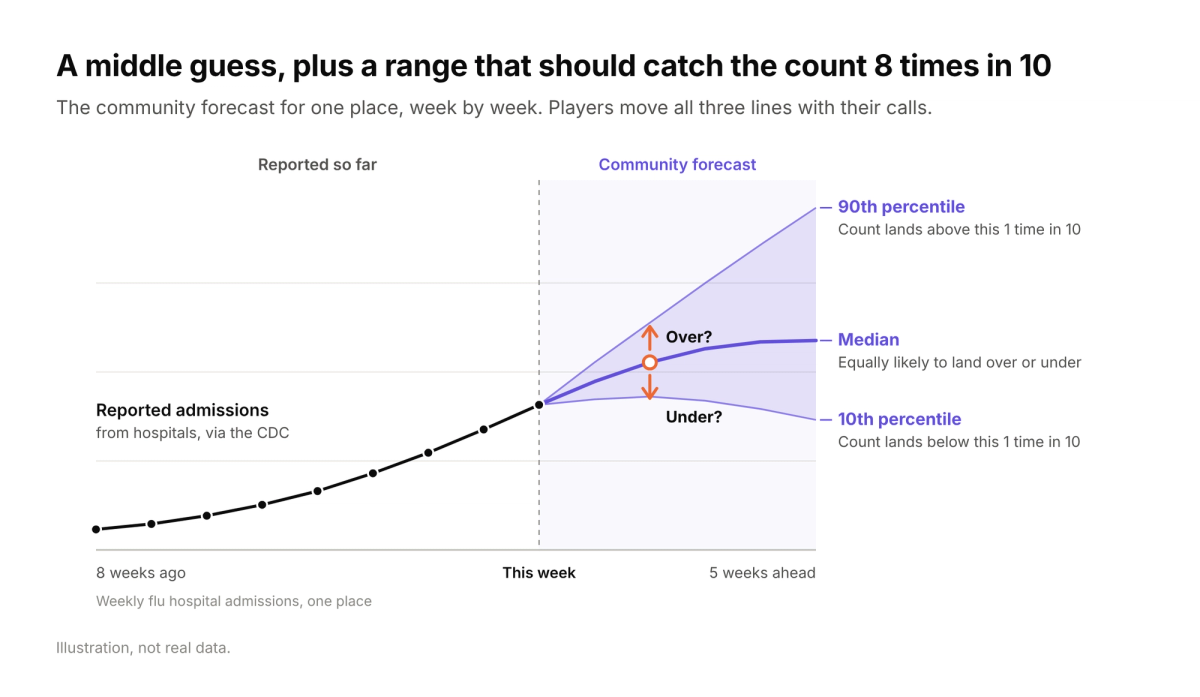
Anyone can play. There's no wallet, crypto or money at risk. Modellers can upload their usual FluSight forecast file as it is.
How it works
Playing is simple: decide whether the real count will come in over or under the community forecast, and back that call with points.
- Right, and you get double your points back. Wrong, and you get nothing. Your call also nudges the forecast, so the next player has a new number to beat.
- Draw it instead. Sketch the line you expect across the coming weeks and the game turns it into a set of calls, or upload a CSV from your own model.
- New points arrive every week you sign in. By default they're spread across places and weeks for you.
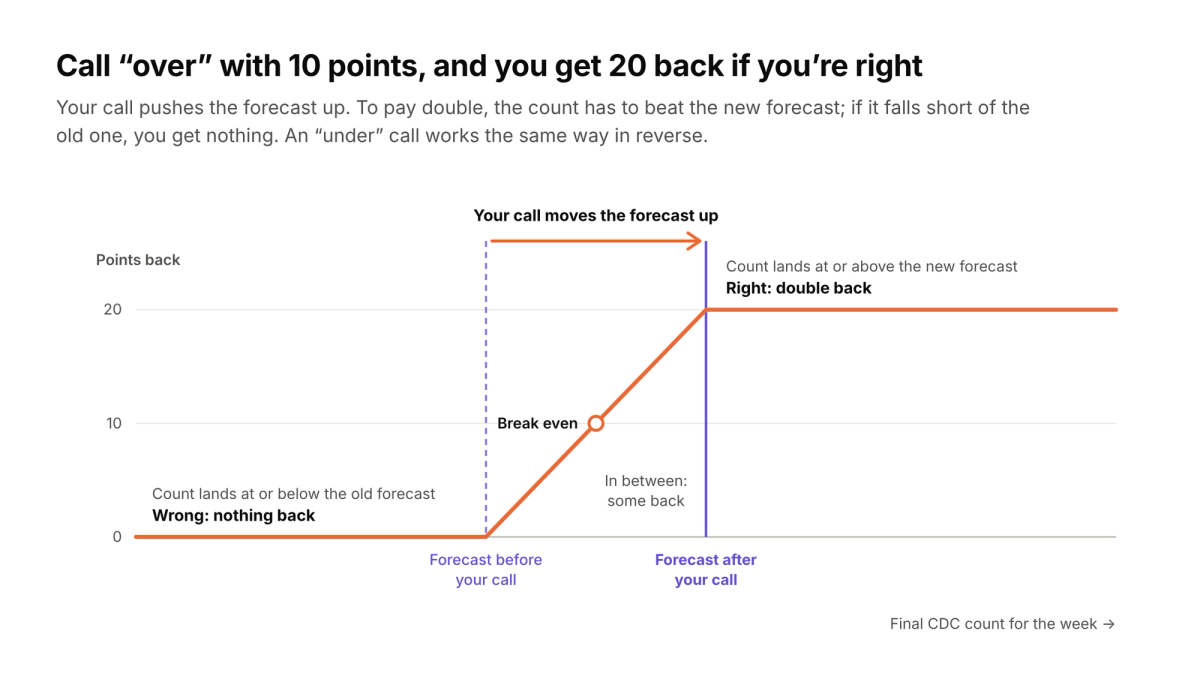
Each week is scored once the CDC's count is final, so forecasting the CDC's revisions is part of the game. Two prize rounds, one for the fall and one for the full season, each pay $3,000 to their top five players (Terms).
Why build a market for the flu?
The CDC already has a strong forecast. FluSight combines models from research teams into an ensemble that has been among the most accurate flu forecasts for years. We aren't trying to beat it; we want to know whether a well-designed crowd can add to it. Aggregated human forecasts have been competitive with statistical models for flu and COVID-19, and people in hospitals and health departments often see a local surge before it reaches national data.
Prediction markets haven't always delivered. A recent study of Polymarket's flu markets found they lost to the FluSight ensemble, and blamed thin trading and bets spread across impossible outcomes. The Flu Forecast Game is built around those failures:
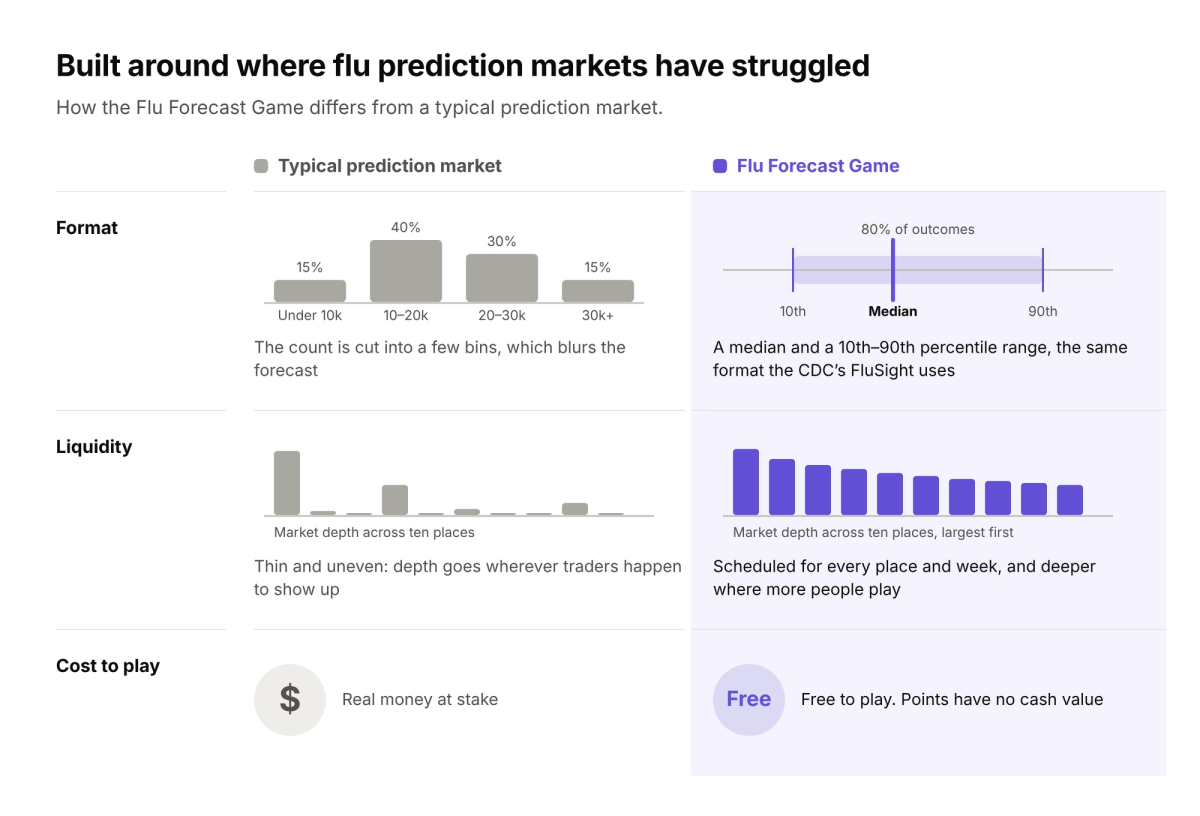
The engine is a new design we call a median market, built on research into scoring-rule markets (Lambert, Pennock & Shoham; Frongillo & Waggoner). Each over/under call is a trade, and the payout rule rewards moving the forecast toward the truth. The project is led by Rafael Frongillo and Bo Waggoner of Gensyn's research team, and runs on Gensyn's public testnet, so every prediction and settlement can be checked.
Early days, in an early season
It's too soon for results; the leaderboard fills in as the CDC finalizes each week's count. But the timing makes for a good test. Flu arrived early this season. Early on, hospital admissions ran at about four times last year's level, and the CDC's estimated hospitalization rate was the highest for that point in a season since 2010–11 (Medical Daily). Is this an early peak, or the start of a big season? That's exactly what the game asks.
Building it taught us a few things:
- Hide the market. Testers found a trading screen heavy going, so the default view asks one question and lets you draw a line. The market is still there in the Trader view.
- Don't let one player drag the forecast. Liquidity grows with trading activity, so each player's pull shrinks as more people join.
- Reward the whole map. We dropped per-state prizes, which would have rewarded piling into the thinnest, easiest-to-push markets.
What's next, and how to play
After the season, we'll score the community forecast against the FluSight ensemble and its models on the CDC's final counts, and publish what we find: whether the crowd was accurate and well calibrated, whether it added to the models, and whether it spotted turns in the season early.
To play, go to flu.delphi.fyi, sign in, pick the US or a state, and draw where you think the season is headed. Come back each week as new points and new CDC counts arrive. Questions are welcome in the Delphi Discord or at [email protected].
The flu will do what it does this winter. The question is whether a crowd, given the right tools, can see it coming a little sooner.
Continue reading